Turumi Travel
Launching a travel and medical tourism business to Korea from zero
- Role
- Product & UX/UI designer, founding team member
- Platform
- Adaptive website (Tilda), social media
- Timeline
- [Year – year]
- Team
- Business owner, CEO, me [anyone else?]
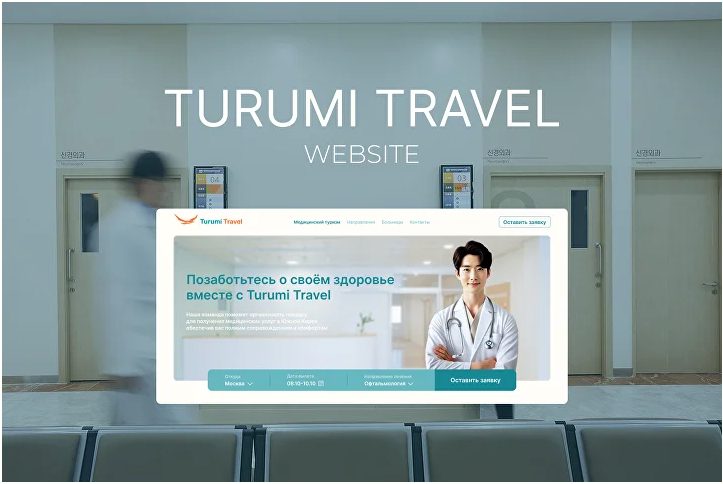
Overview
More than a website: I helped a new business get to market.
Turumi Travel is a new company organising trips to South Korea: medical tourism, personal tour programmes and group tours.
I joined at the very start, when the business had only an idea. I was not just the designer, I was part of the team that launched the business: from the value proposition and the name to the website, social media, SEO and advertising.
To speed up the launch, I worked on the website, social media and print materials while the business owner and the CEO handled registrations and partner communication.
How do you launch a new brand with no audience, no traffic and a small team, as fast as possible?
The business needed to start selling quickly, while partners were still being signed, and the offer itself changed constantly: tours could be updated several times a day.
Process
-
Discovery
Briefing with the business owner, research of travel businesses and their websites, the product we could offer and who would buy it.
-
Strategy
Value proposition, the main idea and the name, the customer journey.
-
Launch plan
Priorities and the order of launching the directions: what goes live first.
-
Website
User research, user flow, wireframes and prototypes, usability testing, design and build in Tilda.
-
Growth
SEO, advertising, social media and print materials.
-
Iteration
Constant updates of the live website and improvements based on analytics.
Research
Market, competitors and the people who would buy the trips.
Challenge
Competitors
I studied travel businesses and their websites: how they present tours, build trust and lead people to a request.
Audience
Value proposition
Naming
I developed the name from the idea and the values of the project.
Key decision: launch step by step
Instead of waiting until every direction was ready, I suggested launching them one by one, so the business could start selling as early as possible.
-
Medical tourism
[Why this direction went first, what it gave the business.]
-
Personal tour programmes
[When it launched and why it came second.]
-
Group tours
[When it launched and what made it possible.]
Website
I designed the user experience and built an adaptive website in Tilda: from the user flow and wireframes to the final design.
Working at startup speed
Adapting the design process to the pace of the business.
The website was very dynamic: tours could change several times a day. The business owner needed results as soon as possible, so for most updates I moved from the full cycle of mock-up, prototype and build to editing the live website directly.
This was a conscious trade-off: speed mattered more than a perfect process, and I had to switch between tasks quickly.
Growth: SEO & advertising
When the product was ready enough, I took on the marketing strategy and SEO.
What I did
I analysed search queries, set up keywords and tags, launched advertising and made visuals for it, then kept analysing the results and improving.
The website reached the first positions and the first page of search results.
[×N]
[growth in traffic or requests after the SEO setup, and over what period]
Beyond the screen
Other ways I contributed to the launch.
Social media
I researched the market and the audience’s interests, built a content plan with the schedule and themes of the posts, created the visual concept and made the materials.
Presentations & print
Presentations and print materials for clients and partners.
Partnerships
At a medical tourism conference in Korea, I talked to potential partners and made deals with them.
Results
For clients
For the business
- Started selling step by step, without waiting for every direction to be ready
- First positions and the first page in search results
Turumi Travel let me work not only as a UX/UI or product designer, but as a person who has an impact on the business.
Next project